
Discover how GLP-1 trends are transforming nutrition innovation with protein, fiber and low-sugar solutions that support satiety and metabolic health.

Introduction Points: Glucagon-Like-Peptide-1 (GLP-1) Receptor Agonists (RA’s) are drugs that have been used to treat patients with diabetes for over 15 years for blood glucose management and are now increasingly being used to help with weight loss. GLP-1 RAs activate GLP-1 receptors found in the brain, intestines, and pancreas. Prolonged activation has a cascade of effects, including slowing gastric (stomach) emptying and triggering satiety hormones, leading to more fullness than usual. Increasing satiety results in less calorie intake – the key mechanism by which GLP-1 RA’s help with weight loss. However, to make the goal of fat loss and improved metabolic health successful and sustainable requires consumers to take diet and lifestyle actions.
How to Optimize Your Product for Consumers taking GLP-1 RAs
Muscle Loss is a Major Challenge for those on GLP-1 RAs (1). Losing muscle mass as part of weight loss undermines metabolic health and longevity in the long run, and makes weight regain more likely. Thus, those taking GLP-1 RAs must both do resistance training and prioritize consuming protein within the fewer overall calories (kcal) they are now consuming. For example, if they consume a 600kcal meal, they may aim for >40% of those kcal to be from protein. It is also important to incorporate fiber and micronutrient-rich plant foods to maintain health.
Thus, there is no room for sugar and micronutrient-poor carbohydrates here. The goal is to lose adipose tissue, not muscle. You can help by creating products that are no/low calorie and sugar-free, allowing the fewer kcal in their diets to be allocated to protein and micronutrient-rich food instead. You can enable consumers to still enjoy sweetness without kcal, by using non-caloric sweet ingredients such as stevia leaf extract. You can also help by creating protein and micronutrient-rich products that support muscle mass maintenance and health.
How to Optimize Your Product for Consumers Who Seek Weight Loss without GLP-1 RAs
Consumers who discontinue GLP-1 RAs or who cannot / do not want to take them and still wish to lose weight can use diet and lifestyle measures. As seen with GLP-1 RAs, one of the most powerful weight loss levers is to promote satiety. You can create products that help to promote satiety by making them:

Sugar is not as satiating as other food components, leaving consumers hungry for more. Non-caloric sweet ingredients do not appear to have the same effect (2), and can be used as part of a satiating diet, allowing more of the kcal consumed to be allocated to protein and micronutrient rich foods. Furthermore, fructose (the sweet part of sucrose) overconsumption induces leptin (a key satiety hormone) resistance (stops working as effectively) (3). You can help consumers enjoy sweetness without fructose by offering natural, non-fructose sweetness via stevia instead.
Fiber achieves many of the same functions as GLP-1 RAs, slowing gastric emptying, increasing satiety hormones (including GLP-1), and inducing satiety. Many studies demonstrate the efficacy of fiber in weight loss, even specifically visceral fat loss, independent of weight loss (4). In human studies, cellulose from plants significantly induced increases in GLP-1, and inulin has been demonstrated to improve satiety, reduce energy intake, and reduce percentage of body fat (5, 6, 7). While too much fiber acutely may cause GI symptoms (the major side effect of GLP-1 RAs which have a common mechanism of action), most consumers’ diets lack sufficient fiber, so creating products with a well-calibrated amount of fiber will be very helpful.
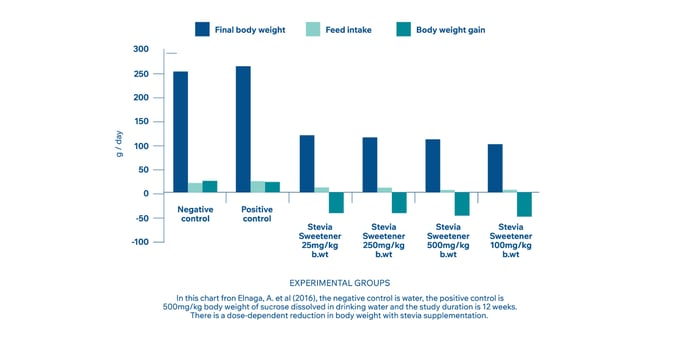
Aside from helping consumers avoid sugar’s satiety undermining effects and kcals, studies indicate that stevia helps with weight loss by supporting satiety. Animal studies indicate a dose-dependent result of stevia assisting in lowering energy intake and thus inducing weight loss compared to both water alone and sucrose-water (8). Human studies also suggest that stevia can aid in promoting satiety, reducing energy intake, and improving weight loss. A double-blind, acute RCT revealed that drinking a stevia-sweetened beverage prior to a meal resulted in less energy intake compared to beverages with maltodextrin, glucose, sucrose, and plain water, mirroring participants’ statistically significant fullness ratings (9). Significant weight loss and reduced waist circumference was achieved in another human study that replaced added sugar with stevia in non-diabetic and prediabetic overweight subjects (10). A meta-analysis of controlled human intervention studies observed that low/no calorie sweetened (incl. stevia-sweetened) food/beverage consumption prior to meals assisted in lowering overall energy consumption (11).
Conclusion:
You can help consumers in their weight loss and body composition goals by offering products that do not ‘waste’ calories on micronutrient poor, non-satiating sugar, and that instead nutritiously support muscle maintenance/gain, and overall health. Removing sugar, adding protein, fiber, and/or stevia can help in this aim. If you would like help to formulate your product to help consumers to reduce their sugar intake and still enjoy no/low calorie sweetness.
“Some articles on this blog are contributed by external authors. The views and opinions expressed are those of the contributors and do not necessarily reflect the official policy or position of Nutriba. While we aim to share valuable perspectives, we make no representations regarding the accuracy or completeness of third-party content and disclaim any liability arising from its use.Content is for informational purposes only and should not be considered medical or professional advice.”
- Alexandr, C. et al. (2025), ‘Glucagon-like peptide-1 receptor agonists and muscle mass effects’, Pharmacological Research, Volume 220, 2025, 107927
- Buchanan, K.L., et al. (2022), ‘The preference for sugar over sweetener depends on a gut sensor cell’, Nat Neurosci 25, 191–200
- Shapiro, A. et al. (2008), ‘Fructose-induced leptin resistance exacerbates weight gain in response to subsequent high-fat feeding’, Am J Physiol Regul Integr Comp Physiol 295: R1370–R1375
- Barakat et al. (2024), ‘Satiety: a gut-brain relationship’, The Journal of Physiological Sciences, 74:11
- Alonso-Allende, J., et al. (2024), ‘Health Effects and Mechanisms of Inulin Action in Human Metabolism’, Nutrients, 16(17), 2935
- Guess, N.D., et al. (2015), ‘A randomized controlled trial: the effect of inulin on weight management and ectopic fat in subjects with prediabetes’, Nutr Metab (Lond). 2015 Oct 24;12:36
- Alptekin, İM., et al. (2022), ‘Effects of β-glucan and inulin consumption on postprandial appetite, energy intake and food consumption in healthy females: A randomized controlled trial’, Nutr Health. 2022 Sep;28(3):433-442
- Elnaga, A., et al. (2016), ‘Effect of stevia sweetener consumption as non-caloric sweetening on body weight gain and biochemical’s parameters in overweight female rats’, Annals of Agricultural Science (2016) 61(1), 155–163
- Stamataki NS., et al. (2020), ‘Stevia Beverage Consumption prior to Lunch Reduces Appetite and Total Energy Intake without Affecting Glycemia or Attentional Bias to Food Cues: A Double-Blind Randomized Controlled Trial in Healthy Adults, J Nutr. 2020 May
- Raghavan G., et al. (2023), ‘Effect of Sugar Replacement with Stevia-Based Tabletop Sweetener on Weight and Cardiometabolic Health among Indian Adults’, Nutrients. 2023 Apr 3;15(7):1744
- Lee HY., et al.(2021), ‘Effects of Unsweetened Preloads and Preloads Sweetened with Caloric or Low-/No-Calorie Sweeteners on Subsequent Energy Intakes: A Systematic Review and Meta-Analysis of Controlled Human Intervention Studies’, Adv Nutr. 2021 Jul 30;